Monday, August 17, 2020

When to seek help for your child: Children (Part 1 of 3)


And he said:

Your children are not your children.

They are the sons and daughters of

life’s longing for itself.

They come through you, but not from you.

And though they are with you,  they belong not to you...

you are the bow from which your children as living

arrows are sent forth.

from Kahlil Gibran,  The Prophet

Previously I’ve shared work from one of the UNR faculty, Tom Lavin, MFT, LADC. He recently wrote a piece about when to seek help if your child is struggling.

While all of us are facing increased stress due to COVID-19, children are especially vulnerable. There is the disruption to their schedules, being out of school, isolation from peers, trying to learn in their home environment and more. They are also surrounded by reminders about the fragility of life.

In a three-part series I will share Lavin’s advice* on when to seek help, first for children under the age of 12, and then for adolescents (12 and up). The series concludes with some helpful suggestions about questions to ask when considering therapy. 

Today’s post focuses on children. Specifically, if you see any of the following you in your child you should consider seeking outside help:

·        Fall in school performance

·        Poor grades in school despite trying very hard

·        A lot of worry or anxiety

·        New onset hyperactivity/fidgeting that persists

·        Persistent nightmares

·        Persistent disobedience or aggression

·        Provocative opposition to authority figures

·        Frequent, unexplained temper tantrums

 If you have noticed any of the above signs in your child, it may be time to enlist the help of a professional. The first step is to talk to your child’s pediatrician/primary care provider. They can then guide you in the right direction.

It’s a hard time for everyone, even the youngest among us.

Check back next Monday for some of the signs that may signal it is time for you to consider outside help for your adolescent.

*The following resources were cited by Lavin: 

"Understanding Teen Depression” by Emmpfield and Bakalar  

“Overcoming Teen Depression: A Guide for Parents” by Miriam Kaufman, M.D.

  American Academy of Child and Adolescent Psychiatry: www.AACP.org

Sunday, July 12, 2020

Psychiatry, Racism and the Census

table taken from page 155 of the October 1851 issue of the American Journal of Insanity


The above table appeared in the October 1851 issue of the American Journal of Insanity

The June 23, 2020 issue of Psychiatry News focuses on Structural Racism in American Psychiatry. In that article I was shocked (and horrified) to find the above table. The article explains that the 1840 census added a new category, "insane and idiotic."

The article states: 

The census reported that in free states, there was one insane or idiotic person for every 144.5 Blacks; the ratio for whites was 1 to 867. However, in slave states, the ratio of insanity for Blacks was 1 to 1,558. Also, the farther north one went, the higher the ratio of insanity in Blacks, and the farther south one went, the lower the ratio. The ratio of insanity among Blacks in Maine was 1 in 14, while in Louisiana the ratio was 1 in 4,310. John McCune Smith, the first Black licensed to practice medicine in the United States, and Edward Jarvis, a physician and father of American biostatistics, wrote scathing rebuttals highlighting fundamental methodological flaws. John C. Calhoun, who had resigned his position as vice president to become a senator from South Carolina, supported the findings of the census, proclaiming, “Here is the proof of the necessity of slavery. The African is incapable of self care and sinks into lunacy under the burden of freedom. It is a mercy to him to give this guardianship and protection from mental death.” John McCune Smith’s conclusion was different: “Freedom has not made us mad; it has strengthened our minds by throwing us upon our own resources.”

It is so heart-wrenching to look back 180 years and see this example of both individual and systemic racism. I wonder how the words that are said today will be viewed by those who will come after us...

To read the entire article click HERE.

Sunday, June 21, 2020

COVID Facts

A Guide to What to Know About COVID-19 | Smart News | Smithsonian ...

This past week I had to complete a "returning to work" module on Covid 19 knowledge for the University of Nevada. While I dreaded completing yet another (boring) on line training, this module actually had some information that I found helpful. I'd like to share a few of these facts as I've found getting good, reliable data about the COVID-19 challenging the past few months.

How many virus particles does it take to become infected with COVID-19? It is estimated it takes approx. 1000 virus particles to become infected with COVID-19.  Here is a list of approx. how long it would take to inhale 1000 particles by different activity:

  • Breathing: an infected person sheds approx. 20 particles per minute, so it would take about 50 minutes to inhale 1000 particles and potentially become infected. 
  • Speaking: an infected person sheds approx. 200 particles per minute, so it would take about 5 minutes  to inhale 1000 particles and potentially become infected. 
  • Cough: One cough contains approx 200,000,000 viral particles, so exposure time to inhale 1000 particles is immediate. 
  • Sneeze: One sneeze contains approx 200,000,000 viral particles, so exposure time to inhale 1000 particles is immediate. 

How long does SARS-CoV2 (the virus that causes COVID-19) last outside the body? (From a study and paper by the New England Journal of Medicine, CDC, UCLA, Princeton)

  • As an aerosol in the air--up to 3 hours*
  • On copper--up to 4 hours
  • On cardboard--up to 24 hours
  • On plastic--2-3 days
  • On stainless steel--2-3 days 
*Researchers used a nebulizer to simulate coughing or sneezing and found that the virus became an aerosol. 


Because the SARS-CoV-2 virus may remain viable on non-porous surfaces for several days, you should disinfect surfaces using a product that meets the EPA criteria for use against the virus. The University of Nevada uses TB-Cide Quat to disinfect. An important note. There is a difference between cleaning (wiping off dirt/grime) and disinfecting a surface. To disinfect, you need to spray the surface from approx 6" away, and allow the disinfectant to sit on the surface for approx. 2 minutes. You can then wipe the surface off, and finish by washing your hands.

So friends, wear your mask, wash your hands, and stay safe.

Monday, June 8, 2020

Strengthening your relationship during COVID isolation

The Meaning of Love - Joshua Hehe - Medium

Although always a prevalent topic, since COVID isolation began my patients have been talking about their relationships even more than usual. It must be that people are inside, spending more time with their partners/families. That can be a great thing, or it can be challenging (or maybe a bit of both).

I've been learning about couple's therapy this year as part of my psychiatry residency, and one of my texts is ACT with love by Russ Harris, MD. In this book, Dr. Harris applies the principles of Acceptance and Commitment Therapy to helping couples to stop struggling, reconcile difference, and strengthen their relationship. It has a lot of great exercises that would be helpful for nearly any couple at any stage of their relationship. (To learn more or purchase a copy click here.)

He shares a poetic metaphor for a healthy relationship. He writes:

If two people want to build a fantastic relationship, each needs to be like a mountain. A mountain is whole and complete in itself--and yet when it encounters another mountain, between them they create something new: a valley. A healthy relationship is like two towering mountains with a magnificent valley between them through which the river of life flows strong and fast and free. Neither mountain  needs the other--and yet their connection to one another gives rise to a lush valley teeming with the wonder of nature. 

Many people look to their partner to complete them, to solve all their problems,  to make them whole, or to fix them. Alternatively, they may chose someone that they think they can save. If you recognize some of these motivations in your relationship, you're likely running into problems. Dr. Harris describes a mountain as whole and complete with a firm foundation and clear borders, yet able to be part of a rich and luscious landscape.

If you'd like to learn more about being that strong and complete mountain then check out Dr. Harris' book. It's worth the read.


Wednesday, May 20, 2020

Relationship between suicide and religious service attendance

What hope means for families of children with rare diseases in ...

A new study published in the May 6, 2020 edition of JAMA looks at the relationship between suicide and other "deaths of despair" and attendance at religious services among health professionals.

Briefly, this study sought to answer the question "Is frequent religious service attendance associated with a lower risk of deaths related to drugs, alcohol, and suicide (referred to as deaths from despair) among US health care professionals?"

The researchers looked at a group of  66,492 female registered nurses and 43,141 male health care professionals in the US. Data from these groups was examined covering a 15+ year time period. Among the female group there were 75 deaths of despair, and among the male group there were 306.

When the relationship between deaths of despair and religious service attendance was examined,  attendance at religious services at least once per week was associated with a 68% lower hazard of death from despair among women and a 33% lower hazard among men compared with those who never attend. The researchers state that these findings suggest that frequent attendance at religious services is associated with lower subsequent risk of death from despair.

To read the full article click here.

Thursday, April 23, 2020

Three minutes to decrease COVID worry

What is Acceptance and Commitment Therapy?


Acceptance and Commitment Therapy (ACT) is a form of therapy based on acceptance and mindfulness combined with behavior change and commitment. It's a form of therapy that is taught/frequently utilized in my current residency program.

One of our faculty who facilitates the resident processing group is Tom Lavin. He wrote out a 3+ minute meditation using ACT theory. While it can be useful in dealing with a whole host of stressors, it can also be very helpful in dealing with COVID-related stress/anxiety/worry that many of us may be experiencing. We might be worried about the health risks for our loved ones or ourselves. We might be worried about the financial fallout. We might be struggling with isolation, or conversely spending more time with family/housemates than we usually do. Or even just getting enough of the basic supplies... (For more on Tom Lavin's resources click here). 

Here's the meditation (shared with permission): 

Accepting, Choosing-Committing, Taking Action 
Tom Lavin MFT, LCADC, ACATA

Accept what is, as it is
Slowly... take a few deep breaths...
Allow your thoughts and feelings to emerge and just be there...
the ones you like... and the ones you don’t like...
take few more deep breaths...
and just let your thoughts and feelings be there...
Take a few more deep breaths...
and let your thoughts and feelings be there...
—not judging them and not trying to make them go away...
Just let your thoughts and feelings be there.
Accepting your thoughts and feelings does not mean you like them
and it doesn’t mean you like the situation ...
Just let your thoughts and feelings be there...let the situation be there...
and then settle into accepting what is, as it is...
If you’re having a hard time accepting what is,
go ahead and accept that you’re having a hard time accepting what is...that
you really wish the thought or feelings or the situation were different...but
they’re not...so you’re willing to accept what is, as it is...

After accepting what is as it is, focus on what’s important to you-is there
something about this you want to change---do you want to change your
perspective? Or change the situation?
What do you want to change?
If you think you can make the change, develop and plan a strategy
to make the change you discern would be good...
...then...engage in NIKE Therapy---be willing to “ just do it”...
Be willing to take positive, assertive action....

However, if you can’t change the situation and you’re struggling with
your perspective..... let go............let go...........let go.....
Let it go for today.
Just let it be.
Let it go... and move on...
Say “Yes to Life”...
... and focus your attention on other people and activities you value.


Image from the Center for Stress and Anxiety Management

Friday, April 10, 2020

Face coverings and how to help health care workers if you sew

How to Sew a Fabric Face Mask Free Pattern - Rae Gun Ramblings

This past week the CDC made the strong recommendation for people to wear face coverings in public. For complete and up to date information on face coverings from the CDC, please click  here.   

In response to this recommendation, the State of Nevada sent out an email to all State employees explaining the different types of masks and their preferred use, as well as providing information on how to make your own mask. 

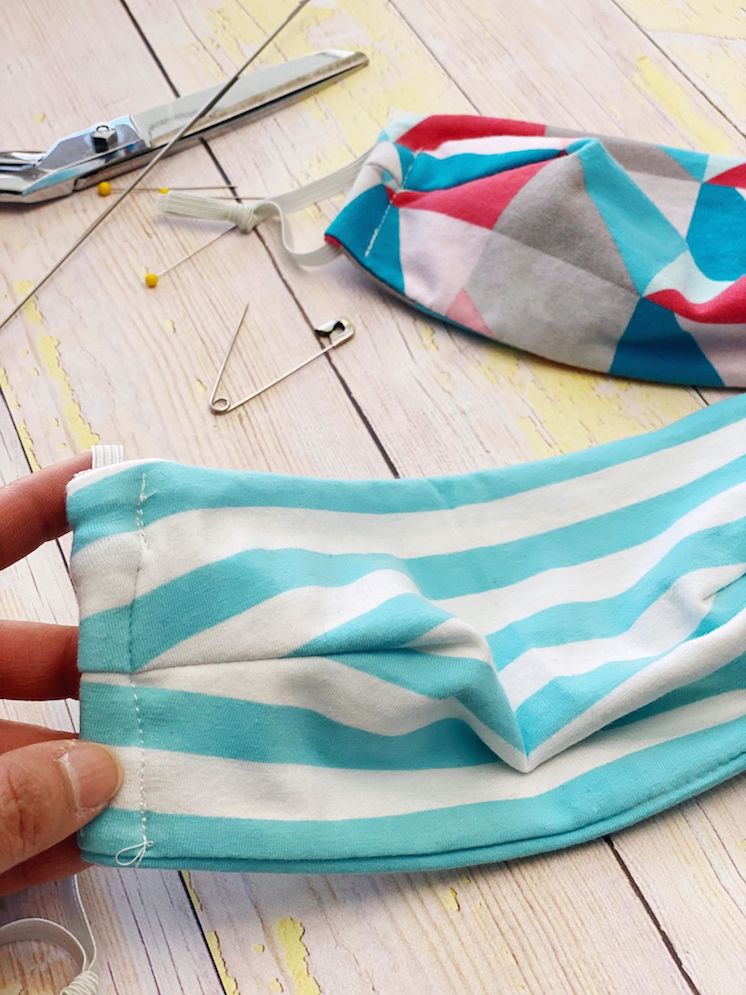
If you like to sew, you can make coverings for your local health care providers in addition to making them for yourself/family/friends/neighbors. I was so grateful when I went for my N95 fitting to find that people in the community had made hundreds of cloth coverings for our N95 masks so that we can extend the number of uses per N95. There was a big bin of cloth masks that we could chose from with lots of fun patterns. Additionally, it's really helpful to have a headband with buttons sewn behind the ears so that providers can hook their cloth mask onto the headband instead of behind their ears. No one had donated any, but I'm sure they would be greatly appreciated as well. 

The information below on cloth masks is adapted from the State of Nevada email. I hope you find it helpful.
      • Can be worn anywhere but should be changed out and washed frequently;
      • If you are able to make a cloth mask, it is recommended to make a few to change out between home, work and other places.
      • The cloth mask for work should ONLY be worn at work.
        • Maintain in a plastic zip-lock bag.
        • Change the zip-lock bag at least once a week
        • Only take home to be laundered, placed in a clean zip-lock bag and brought back to work.
      • Placing a cloth mask over other masks will help keep the other masks clean and last longer.
      • The cloth mask should be able to be laundered in hot water and machine dried without damage or change to the shape or integrity of the mask.
      • Here are some  YouTube ‘How To’ videos for making a mask:
        • How to make a fitted mask – much like an N95:
        • How to make a mask with a filter:
        • How to make a great mask if you can’t find supplies:
        • How to make a mask with a handkerchief/napkin: 
Face masks should fit snugly but comfortably against the sides of the face and bridge of the nose. Ideally, they include layers of fabric, preferably with a filter. Ideally they will allow for breathing without restriction. They should also only be touched when putting them on or taking them off. 

Please stay safe, stay home, and wash your hands.